

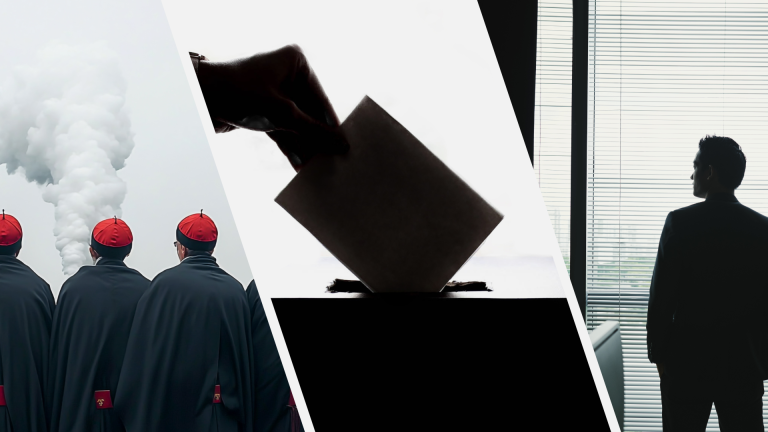
Leading is choosing — but also building.
What if all leaders went through a recruitment process?
Pope, Prime Minister, or CEO — all influence the direction of communities. But are we choosing the right leaders with the right processes? In this article, we challenge traditional leadership selection methods and propose a thought-provoking reflection on the role of strategic recruitment in various contexts.
These decisions, though distinct in form and context, present us with the same challenge: choosing the right leadership.
But what if we looked at these choices through the ‘lens’ of a recruitment process? What similarities (or differences) exist between electing a Pope, a political leader, or a CEO? What if all these leadership roles went through a true recruitment process? And what lessons can we draw for the business world?
The Ideal Profile and the Role of Context
Just as in an organization, choosing a leader begins with defining a profile. The problem is that, so often, this profile is shaped more by current circumstances than by a long-term vision. We elect leaders ‘to solve crises,’ ‘to ensure continuity,’ ‘to unite,’ forgetting that leading is more than reacting: it is anticipating, transforming, inspiring.
In corporate recruitment, technical and behavioral competencies are defined, cultural fit is assessed, and the concept of situational leadership is applied. What about in the political or religious world? The ideal profile is often tacit, symbolic, or conditioned by internal dynamics — whether in the Conclave or within party leaderships.
Closed Processes or Democratic Participation?
The election of a Pope takes place in a secret Conclave, where a restricted group of cardinals deliberates behind closed doors. A new Prime Minister emerges from the polls, through an open process, but one deeply mediated by the media and party apparatuses. In business recruitment, ideally, there is transparency, objective criteria, and the involvement of various stakeholders.
Regardless of the process, the success of any leadership will always depend on the legitimacy it builds and the trust it can generate. In the business world, a CEO needs the respect of the board, the team, and the market. A politician needs votes, but also mobilization. A Pope needs faith — but also pastoral vision.
What if all these leadership roles went through a recruitment process?
- What if future Prime Ministers underwent crisis and negotiation simulations?
- What if cardinals conducted structured interviews with papal candidates?
But we could ensure greater transparency, better alignment with community needs, and more sustainable decisions over time… certainly!
Leadership is a choice. But it is also a construction.
In companies, governments, or the Church, choosing leaders is one of the most complex and impactful decisions we can make.
And, in times of transition, it is fundamental to reflect on what we seek in a leader: someone who maintains what exists? Or someone who challenges, transforms, and inspires?
More than ever, we need leaders with purpose, vision, and humanity. And that begins by rethinking our selection processes — whether they are conducted through polls, conclaves, or interviews.
